Images of Charles, duc
d'Orleans
We have very little
evidence of what the duke actually looked like. As a result, writers and
artists have had a field day imagining him according to their own estimation of
him. This page will continue to grow as I digitize my collection of such
imagined portraits.
The likenesses really fall
into one of three categories:
those produced in his
lifetime or immediately after it,
those produced in the
nineteenth century, and
those produced in the last
hundred years or so.
To take each in order, in
the first half of the fifteenth century, portraiture was possible, but not
always a requirement of patrons. A queen should look queenly. A knight should
look knightly. Whether the eyes were just right was in some cases the last
requirement of the patron (especially, one suspects, if the subject was less
than beautiful). It is therefore very difficult to know whether an image (a
manuscript illumination, a panel painting, a tapestry, etc.) was intended as a
true likeness. The dukes of Burgundy seem to have required some accuracy of
representation. We know this in part because a succession of images of Philippe
le Bon, produced over the course of many years (he liked his image), all show a
very strong resemblance to one another.
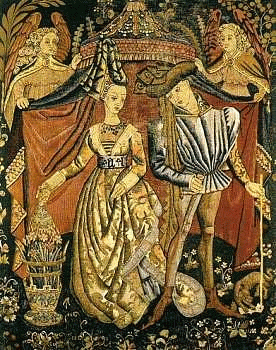
The only representation
that can with any certainty be associated with the duke is this medieval tapestry of Charles with his third wife, Marie de Cleves.
They were married immediately upon his return from captivity at the age of 46.
She was 14. It is hard to say exactly when this tapestry was executed, but it
certainly does not represent the disparity in their ages.
Here is Charles
d'Orleans at the time of his betrothal according to some scholars. The is
the month of April, from the fifteenth-century manuscript called the Très
riches heures of Jean, duc de Berry. One of the most famous medieval images
of the poet appear in the first cityscape known to have been painted: London in
the late fifteenth century, with London Bridge in the background and in the
foreground the White Tower. (Charles was housed in the Tower briefly soon after
his arrival in England.) He
is pictured here three times, once seen at a table writing, once looking
from a window high in the wall onto the street, and once outside the Tower greeting
another man. There have been a number of interpretations of this image, which
is found in a manuscript containing some of his French poems. (The image is
from British
Library, Royal MS 16 F.ii, fol. 73.)
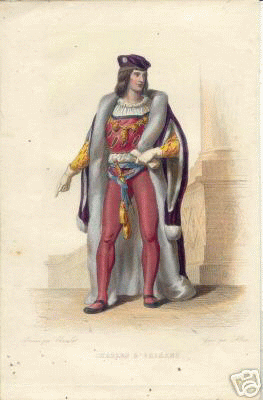
The images produced in the
nineteenth century were (no surprise) mostly very romantic. Artists and writers
seem to have thought of the duke as a handsome, dark-haired, usually fairly
young man. The word "courtly" springs to mind. One of the best known
representations is by Ange
Francois ( with his third wife, Marie de Clèves). Another is this
illustration made for "Le Plutarque Francais," by E.
Mennechet, in 1835. In this case, Charles seems to be a very virile man as
well. There are many more.
Those images produced more
recently vary greatly. Some idealize the duke; others picture him according to
ideas of "French-ness" (as does Matisse).
So stay tuned for the fun.
Return to Charles
d'Orleans page
Rev 6/12